Saturday, 29 March 2014

The Physics Video Procrastination

PhD progress has been slightly approximate in the last few weeks. In moments of research slumps, I usually end up reading PhD comics just to help me feel like I'm not alone. Either that or I'm pottering around with the side project I accidentally signed up for. Whatever the distraction, the particle physics PhD is procrastination at its finest. I'm going to explain how a free day out badly backfired.

It started with an email


There's a constant barrage of emails into my inbox. People advertising events, asking for assignment help, announcing success, announcing failure... yawn. There's even an emailing list that shares amusing links, such as Doge Weather. Most emails get a quick scan and binned, but one caught my eye. A free trip to a public engagement training workshop in London?! Naturally, I signed up. A few weeks later I was walking on Whitechapel Road - the £60 Monopoly street that no one wants, heading towards the workshop at Queen Mary University, London.

The workshop was open to physics PhD students from the entire South East Physics Network (SEPnet). So it started with meeting what felt like an endless supply of SEPnet physicists. After that the day unfolded in a peculiar fashion. Within an hour it was clear that I had signed up to make a fully fledged physics public engagement project... Huh?

That was me.
Read More »

Sunday, 26 January 2014

The String Theory String Images

String Theory and a free online library described with images... it's a good idea!
Python Strings for String Theory...
Read More »

Sunday, 19 January 2014

The Learn LaTeX Paradigm

In the last post, Fluid Dynamics researcher, Jamie Nutter, named Latex as an important tool to one of his kind. Having said that, it's actually an incredibly important tool to physicists across the spectrum. Pretty much all physicists use it. So I'm going to tell you what Latex is, why it's worth using and how you can learn it and use it for free.

For research purposes...

In Light of LaTeX 


LaTeX, to use its proper styling, has nothing to do with the shiny clothing material that might give you a peculiar Google search. In short, it's a document writing system. On a word processor such as MS Office, you type away at your computer and end up with a finished, printable, presentable document, often in the form of a PDF. Well LaTeX is pretty much the same but with an emphasis on its users being mathematicians, computer scientists, physicists... people who want equations on screen. LaTeX's forte is getting equations into a document. 

To do LaTeX magic you need an application that can understand LaTeX writing, and you need some understanding of LaTeX to write it. But before that, this image from Wikipedia really demonstrates what LaTeX is about:
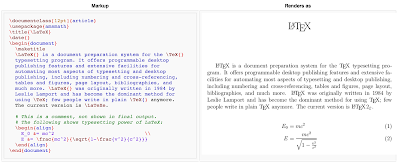
The left side shows what you type into the computer. You need to type in the LaTeX commands for your writing to be understood how you want it. The line that say "\title{...}" tells the computer that the contents of the braces are the document title. After clicking to compile the document, the computer uses the commands and gives you a PDF out, as on the right side. Image from Wikipedia.

LaTeX Applications


To get started using LaTeX, you need to first get an application to do. Here's two good applications that you can install and run on your computer:
  1. TeXMaker
  2. TeXShop. 
However, you might be on someone else's computer or device like a Chromebook. For this situation you can you use ShareLaTeX which runs in your browser. It allows you to login into its website, write and compile multiple LaTeX projects, share projects and has a nice interface.
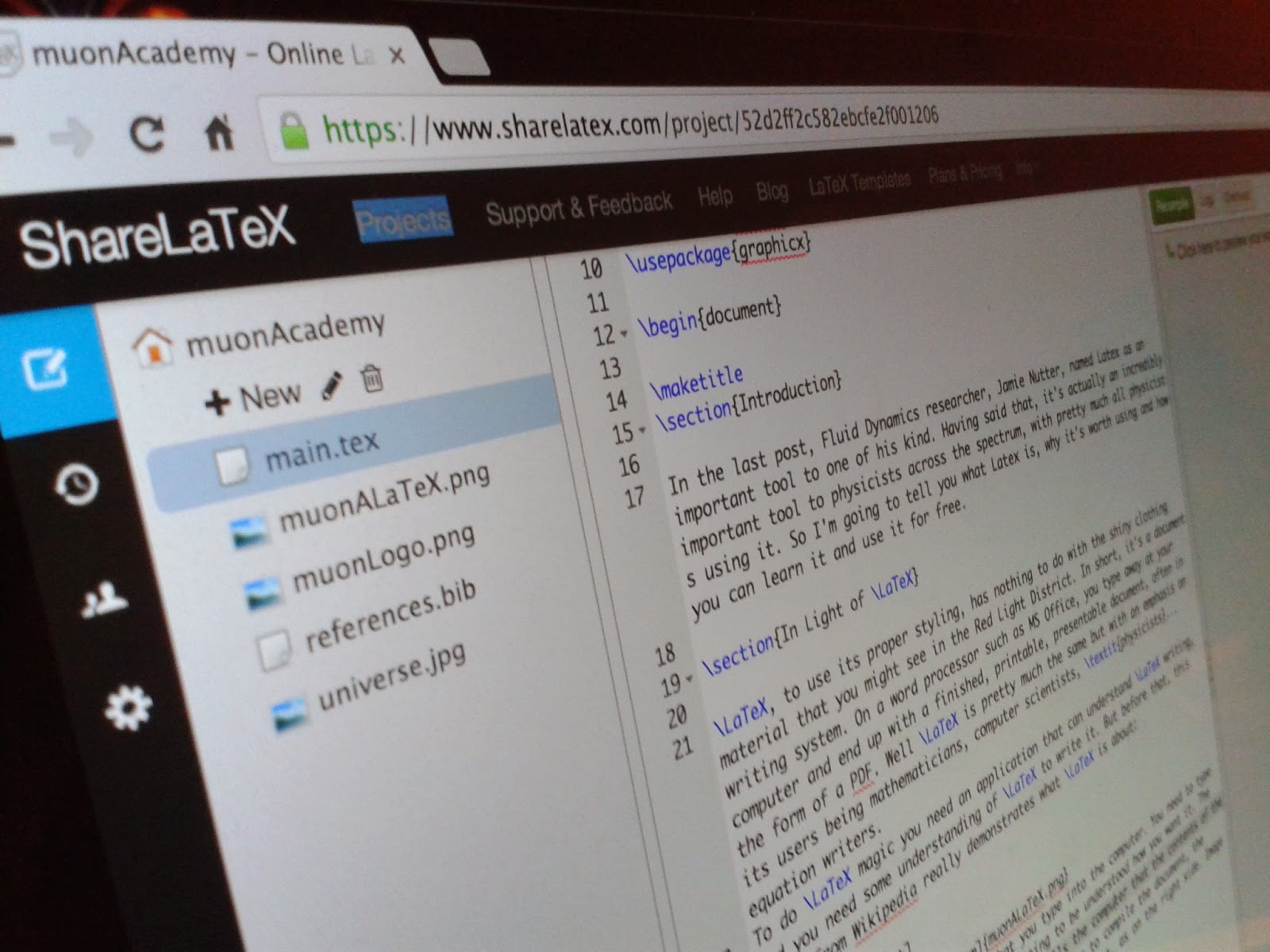
I had a little play at making this post on ShareLaTeX and that's what it looks like as you do.

In Search of Instructions


The best way to learn LaTeX is by doing it. Of course there are places where you can get instructions, but they are usually only good for reference. The following website is a really good reference that I run crying to at least once a week:

However, if you need something you can download, here is a PDF on LaTeX form Oxford:

There are lots more PDFs out there, however they are all pretty much the same. If you ever get a problem in LaTeX, StackExchange has a section just for LaTeX. I often end on there when I get stuck. It's also pretty helpful to have a list of the common symbols in LaTeX, like the one in that link just there.

In Limine LaTeX


A few lines back I said "the best way to learn LaTeX is by doing it", but the best way to do that is via an example. So I have made this blog post into a TeX document just for you* (which explains the variety in layout). I made it in TeXShop. Get it in the link at the end!

Vive la révolution.

Gotta love xkcd!

LearnLaTeXParadigm.tex


The following is a link to this post as a LaTeX document on Google Drive.


*Especially for you from the muon Academy!


Read More »

Monday, 30 December 2013

The Fluid Dynamics Simplification

Apparently we breathe air between 8 and 14 times a minute. Despite this a physicist may tell you that air is negligible, insignificant, of no concern. The reason for this is physics sometimes needs to be simplified to work. One of the most common simplifications is to ignore air resistance altogether. At the point at which air becomes a concern it becomes its own subject: Aerodynamics, a smaller part of Fluid Dynamics. To fully appreciate the topic of Fluid Dynamics, I spoke to Jamie Nutter, a PhD student studying that very topic at Imperial College London.


An Interview with a Fluids Researcher


Me: "Why did you choose to study Fluid Dynamics?"
Jamie: "I’ve always been a fan of F1 and so aero always appealed to me in that way. But I think mainly it was Prof Vladimir Vladimirov (My masters supervisor) who sparked a real interesting in aero while I was doing my masters project. He was the one who first suggested the idea of doing a PhD and encouraged me to pursue one in Fluids."
* Of course Fluid Dynamics has more important applications that just racing. However, Sebastian Vettel would have definitely not won the F1 championship if his team were not considering a whole collection of Fluid Dynamics funk. The effect of air battering the Formula 1 really does affect its performance.*

Me: "Can you tell me a little bit about your research?"
J: "My research is in laminar flow control, funded in part by Airbus, essentially we are looking at the mechanism by which flow over an aerofoil becomes turbulent and attempting to understand and design controls to encourage a more laminar aerofoil. This is to reduce the drag caused by the aerofoil and lead to a reduction in fuel costs. "
** So Jamie looks into how turbulent (rough) flow is created and what mechanisms can encourage a more laminar (smooth) flow. Seeing is believing and below show a picture of turbulent and laminar flow of candle smoke. **


Laminar and turbulent candle smoke. When the smoke rises it starts off laminar, as it continues upwards it gets affected by the air, ultimately creating turbulent smoke. Image courtesy of a Google search.

Jamie continued to explain his research in finer, more technical detail:
J: "We do this by considering asymptotic approximations to the Navier-Stokes equations.
Specifically my work has been in two parts. Firstly I considered a wave like instability (called a Tollmein-Schliching wave) and looked at the effect of having a flow over an aerofoil with a porous section (almost like suction through a porous wall). Secondly I am now considering a streamwise vortical instability (called a Gortler vortex) and am looking at the effect of varying curvature, such as you have on the underside of a wing."

Aerofoil: a cross section of an object designed to alter flow. Image courtesy of another Google search.

Me: "Do you know of any good, free resources, perhaps that you used, on Fluid Dynamics?"
J: "There aren’t that many free resources that I know of. Being a member of Imperial allows me access to plenty of papers and journals, which is invaluable. But other than that there isn’t much. If we want, say, a cross-section of a particular wing we can get this off Airbus but that is only because we are funded by them."
Me: "What would you say to someone starting their journey to a career in Fluid Dynamics? Are there any particular pitfalls or rewards to watch out for?"
J: "I’d encourage anyone starting out in Fluids, it’s very enjoyable and a really applicable part of maths to the real world. There are plenty of opportunities for jobs. However if you’d like to follow the academic route it is very competitive, there aren’t that many post doc. positions and you have to be prepared to travel around a bit to find them.
The work it self should be interesting, there are lots of areas in Fluids to study. Our laminar flow control study is interesting but also Micro Fluids, Biological Fluids, and Environmental Fluids have some really interesting applications. You may need to be prepared to do a lot of coding, and researchers for some reason love FORTRAN, and writing up in LaTeX but if you don’t mind that too much the maths can be a real joy."
Me: "I want to study Fluids..."


A Reservoir of Resources 


So this is the section where I point you to the places that you can learn about Fluid Dynamics. Regardless of what factor of Fluid Dynamics floats your flapper, you will need to know the core components.

Level 1 (HyperPhysics)

I like to start light where I can, HyperPhysics is light, Level 1 and has a good section about fluids: Fluids at HyperPhysics.

Fluids at HyperPhysics.

Level 2 (Fitzpatrick)

After Level 1 it's a big jump, The Fitzpatrick Physics Files post landed a reet good reservoir of resources at Level 2. Here's the ones on Fluid Dynamics: Fitzpatrick's Fluid Dynamics. These ones are really good.

Fitzpatrick's Fluid Dynamics (Mechanics).

Level 3 (ArXiv)

As Jamie mentioned he uses plenty of papers. For anyone that isn't a member of a university, the workaround is to use ArXiv. This landed in The ArXiv Repository post way back in April 2013. There is a section devoted to Fluid Dynamics on ArXiv: Fluid Dynamics at ArXiv.

Fluid Dynamics at ArXiv.

Coding

Jamie also disclosed that life will be easier if you know how to code. I am still a believer that C++ is the best starting place for coding - The Pasture of C++ Notes post.

That Bit at the End...

It's one of the most fascinating places to see physics and mathematics factify and formulate the universe around us. Hats off to Jamie Nutter. This was Fluid Dynamics:


Read More »

Tuesday, 5 November 2013

The Academy-Keeping Corolary

The mission has been making some steady progress recently. But now it's time to start setting the sails to pick up some speed, but to do so, there needs to be a bit of house-keeping. The main place that needs an update is the lists. Now is the time for that academy-keeping.

Setting the sails of the muon Academy.

List-en Update!

The lists have rightfully been renamed to: List 1, 2 and 3, where 1 is the new starting level. These have been added to the header bar for quick access. List 1 was blogged here almost a year ago, but it's gotten a little bit hidden now. Even further back, I blogged about a page that Gerard t'Hooft constructed called "how to become a good theoretical physicist". The Gerard t'Hooft Theoretical Physicist Guide is essentially List 2. List 3, well that's the really tricky one. If you need a List 3 now, the Perimeter Institute advertise their syllabus online, this was blogged about in the Perimeter Institute Video Inclusion post. With great lists comes great new links and as the lists catch the wind, links to the relevant blog posts will be added to the lists.

Back to the Booty

Next time, in spirit of the second sentence of this post, it'll be fluid dynamics time!

Read More »